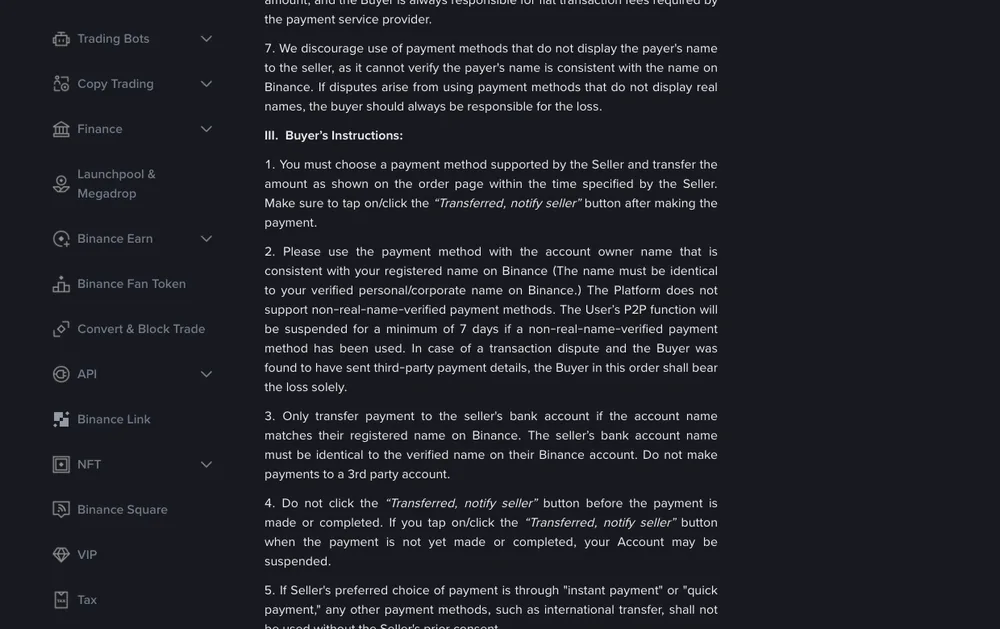
Binance treats it as a breach of its P2P rules, and the cost falls on you. The P2P User Transaction Policy says the account you pay from must be in a name identical to the one Binance verified for you, and that paying with a method that is not verified in your real name gets your P2P function suspended for at least seven days. If the order then turns into a dispute and you are found to have sent third-party payment details, the loss on that order is yours alone.
Sellers are held to a matching rule: the account they collect into has to carry their own verified name. So every P2P order has two names to compare before any money moves. One is the name on your wallet against the name Binance verified for you. The other is the name on the seller's payment details against the seller's verified name.
What Binance's P2P policy says about the name on your payment account
The rule sits in the buyer's section of the Binance P2P User Transaction Policy, a support-centre page that covers makers, takers and verified non-CN users. Here is how it opens:
“Please use the payment method with the account owner name that is consistent with your registered name on Binance (The name must be identical to your verified personal/corporate name on Binance.)”
The same paragraph says the platform does not support payment methods that are not verified in the user's real name, and then sets the penalty: “The User’s P2P function will be suspended for a minimum of 7 days if a non-real-name-verified payment method has been used.” Seven days is the floor. A separate passage, about account restrictions in general, says Binance will remove a suspension “as soon as possible once the reasons for the suspension no longer exist”, and that it has no obligation to tell you when that will be. Plan for a week without P2P at the very least, with no end date promised.
The paragraph closes on money rather than access. When there is a transaction dispute and the buyer is found to have sent third-party payment details, “the Buyer in this order shall bear the loss solely.”
“Identical” is a strict word to build a rule on. It leaves no obvious room for a shortened first name, a dropped family name or a second spelling of the same name, so treat any difference you can see between your wallet's name and your Binance name as a reason not to pay from that wallet.
One more line, from the policy's general trading instructions, covers payment methods that do not show the payer's name to the seller: “We discourage use of payment methods that do not display the payer's name to the seller, as it cannot verify the payer's name is consistent with the name on Binance.” If a dispute comes out of a payment like that, the policy says the buyer should always be responsible for the loss. Binance's pages deal with the account holder's name in general terms and stop short of how any particular wallet stores or displays it. Whether your transfer shows your name to the person receiving it is a question for your wallet's own help pages or customer support, and it is worth asking before you rely on that wallet for P2P.
What happens to an order paid from an account in another name
Binance's P2P Appeal Handling Rules deal with this case on the seller's side, under payments where the verified information does not match. When the name on the buyer's payment account differs from the verified name on Binance P2P, the rules set out what follows:
- The buyer's P2P function is suspended for breaking the Binance P2P transaction rules.
- The crypto is not released.
- The seller is asked to refund the full amount to the buyer.
- The order is cancelled after the seller submits proof of the refund and the buyer confirms the refund has been received.
- Any fees incurred are for the buyer to cover.
If you have already paid from the wrong account, tell the seller in the order chat what happened, so the refund request sits inside the order record and not in a separate messaging app. When the money comes back, check that it has actually landed in the account you paid from before you confirm anything, because your confirmation is the step that lets the order close.
Where to see your Binance verified name before you pay
Binance's blog post on checking your verified name points to one field: Account holder name, on the form for adding a P2P payment method. Binance fills it in with your verified name, so whatever appears there is the name your wallet has to match.
On the P2P website
- Log in and open the Binance P2P web page.
- Click [More] on the navigation bar, then [Payment Methods].
- Click [+Add a payment method] and choose any method from the dropdown.
- Read the name pre-filled under [Account holder name].
In the Binance app
- Make sure the app is in Pro mode, then go to [P2P Trading].
- Tap [Profile] in the bottom-right corner, then [Payment Method].
- Tap [Add a payment method] at the bottom of the screen and pick a method.
- Read the name pre-filled under [Account holder name].
Both sets of steps end once the name is on screen. You don't have to finish adding a method you have no plan to use. These menu paths come from a 2022 Binance blog post, so go by the labels on your current screen; if you cannot find the menu, ask Binance P2P customer support through live chat where to see your verified name.
Now open the wallet you are going to pay from and find the account holder name it shows for your account. Put it next to the Binance name and go through it piece by piece: first name, family name, any middle name, and the spelling of each. If you keep more than one wallet, or a wallet and a bank account, check every one you might pay from, and use only an account whose name passes. If EasyPaisa is your wallet, Binance P2P with EasyPaisa: Buying and Selling USDT Safely covers the payment flow this check fits into.
If the name Binance verified for you is the wrong one
The pre-filled name can itself be the problem, when it does not match the name on the identity documents you submitted. Binance's blog recommends getting it corrected as soon as possible, and gives two ways to do that:
- the name correction request form, where the blog says “our team will get it corrected for you within three weeks”;
- Binance P2P customer support through live chat, to tell them about the discrepancy.
Hold off on P2P orders until the corrected name shows under Account holder name, then compare it with your wallet again. If you cannot locate the form from where you are in the app, live chat is the other route the blog gives.
Checking the seller's name before you send money
The policy applies the same test to the seller. The buyer's section says: “Only transfer payment to the seller's bank account if the account name matches their registered name on Binance.” It ends with a plain instruction: “Do not make payments to a 3rd party account.”
Binance's blog post on avoiding third-party transfers describes how an attempt shows up. These are the signs that involve names and accounts:
- The account you are given belongs to someone else and is in another person's name.
- The name on the account differs from the seller's Binance name, and the seller has an explanation ready. The blog counts this as a red flag: a counterparty should sort out name inconsistencies on their P2P ad, not bring them up with you in the middle of a transaction.
- The seller asks in chat for payment through a method or account that is not listed in the ad, for example by claiming the listed one is not working right now.
The blog notes one exception. In some markets, certain P2P users are allowed to hide their bank account details in the ad for security reasons and can then give the payment account in chat. The person who placed the ad still has to give you their accurate personal account details.
If you notice a mismatch before paying, the blog's advice is to cancel the order straight away, with no need to argue it out with the seller. Before you tap cancel, know what it costs on the day. The policy lists several kinds of buyer cancellation, and repeating the same kind three times in one day blocks you from P2P taker activity for the rest of that day. For the daily cancellation count and the cap on open orders, see Binance P2P Order Limits: 3 Cancellations a Day and 2 Open Orders.
If the money has already gone to an account other than the one specified in the order's payment information, or to a third-party account, the appeal rules leave Binance out of the loss: Binance is not liable, and a refund is not guaranteed. A buyer who keeps paying accounts other than the one the seller specified can have their account suspended by customer service. The third-party transfer post says you can still appeal on the grounds of a third-party transfer after sending the payment, so raise it through the order's appeal and keep the evidence in the order chat.
When you are the seller and the payment comes from a different name
Your half of the rule is in the seller's instructions. The account you collect into must be in a name identical to your Binance verified name, and if a dispute finds that you sent third-party payment details, “the Seller in this order shall bear the loss solely.”
The incoming payment is the part you control on each order. Binance's post on third-party transfers tells sellers to check whether the sender's details match the account details given on Binance P2P. When they don't, it sets out three steps:
- Return the funds to the exact account they came from.
- Tell the buyer why.
- Cancel the transaction.
Keep the refund record from your wallet. Under the appeal rules, an order where the buyer's name does not match is cancelled after the seller submits proof of the refund, so that record is what you will be asked for.
In markets where account details can be hidden in ads, you may not see the buyer's full name until the payment arrives. The blog's suggestion then is to confirm the details in the order chat, and either go ahead when they match or move to a refund or an appeal when they don't.
Releasing the crypto against a mismatched payment leaves the risk with you. The blog says a counterparty might use the inconsistency to try to undo the trade, and that your bank or payment platform “could act upon these inconsistencies and have a reason to freeze your account.” In that situation, the blog adds, “we might not be able to help you out because you permitted the inconsistency to happen.” Whether a payment can still be reversed once you have released the crypto is the question taken up in Can a Mobile Money Payment Be Reversed After You Release?
Who carries the loss when the names don't match
Binance's policy describes the platform as not a party to any P2P transaction, with neither the right nor the obligation to resolve disputes between users. Its pages do say who pays when a name or account is wrong:
| What happened | What Binance's pages say |
|---|---|
| Buyer paid from an account not in their verified name | P2P function suspended for at least 7 days (Transaction Policy). In an appeal, the crypto is not released, the seller is asked to refund the full amount and the buyer covers any fees (Appeal Handling Rules). |
| Buyer found in a dispute to have sent third-party payment details | The buyer bears the loss alone (Transaction Policy). |
| Seller found in a dispute to have sent third-party payment details | The seller bears the loss alone (Transaction Policy). |
| Buyer paid an account other than the one the seller listed, or a third-party account | Binance is not liable and a refund is not guaranteed; repeated cases can get the buyer's account suspended (Appeal Handling Rules). |
| Dispute over a payment method that does not show the payer's name to the seller | The buyer should always be responsible for the loss (Transaction Policy). |
Other questions about the name check
Is my Binance P2P nickname the name my wallet has to match?
No. The policy ties your payment account to your verified personal or corporate name, which is the name Binance pre-fills under Account holder name. The nickname is separate, and the policy says it should not contain “Binance”, names of local banks and payment systems, personal information or other sensitive words. Keep your real name and phone number out of it.
Can I still report a third-party payment after the trade has completed?
Yes. Binance's post on third-party transfers encourages users to report one even when the transaction completed and they received the cash or crypto as intended, and says customer support will look into it. Its warning for anyone who lets the mismatch pass is that if you don't flag it, the counterparty will flag it first, to their own advantage.