A bank account can be frozen after a P2P sale even when the seller did nothing wrong. Binance's support page How to Prevent My Bank Account from Being Frozen in P2P Transactions describes how it happens: some buyers purchased crypto on Binance P2P to trade on other platforms, were scammed there, and reported it to local authorities. The scammers' accounts were frozen, and so were the accounts of the innocent P2P sellers those buyers had paid. The rupees sitting in your account came from a buyer, so a complaint about that buyer's loss can reach you even though your trade was a normal one.
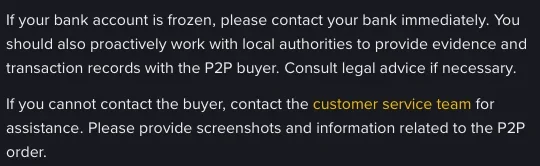
For a seller whose account is already frozen, the advice there is short: “If your bank account is frozen, please contact your bank immediately. You should also proactively work with local authorities to provide evidence and transaction records with the P2P buyer. Consult legal advice if necessary.” Go to your branch first. In the grievance process Rajasthan Police described in May 2026, the branch is also where a formal request for relief begins.
Is your bank holding one amount or blocking the whole account?
Find this out before anything else, because it decides how much of your money is stuck while the complaint is looked into. These are the two forms to tell apart.
| Lien or hold on an amount | Debit freeze on the account | |
|---|---|---|
| What is blocked | A specific sum | Every payment out of the account |
| The rest of your balance | Can still be used | Cannot be moved |
| What to get from the bank | The amount held and the credit it is tied to | Confirmation that the whole account is restrained, and on whose request |
Two High Court judgments from 2026 favour the narrower form. In Shree Balaji Enterprises v. RBI, decided by the Rajasthan High Court on 20 August 2026 and summarised by SCC Online, the court's guidelines say to “place a lien or hold upon the amount rather than debit-freeze the entire account”. They add: “The disputed amount shall be held by lien/hold, instead of freezing the entire account with reasons for wider restraint.”
The Allahabad High Court took a similar line in Ritesh Yadav vs. RBI, which LiveLaw reported on 14 August 2026. It found that continuing a blanket debit freeze over the petitioner's entire bank accounts, “to the extent it operates beyond the amount of ₹36,000/-, cannot be sustained in its present form.”
Both are rulings in particular cases from two states. They give you something concrete to raise with the bank if your whole account is blocked over one credit. What happens to your own account still turns on the request or order behind it.
The P2P order records to collect before you visit the branch
The bank and the police will want to see what the money in your account was for. Put together everything that links the credit on your statement to one completed P2P order:
- The order details from your P2P order history: order number, the crypto amount you sold, the price, the rupee total, and the time the order completed.
- The buyer's name as it appears on the order, next to the sender's name on the incoming payment. If the two differ, say so up front and expect questions about it, since on a P2P order the payment name must match the verified name.
- The full chat with the buyer inside the order, as screenshots.
- The bank statement line for that credit, with its UTR (Unique Transaction Reference). If the buyer paid through UPI, the UPI reference number in your payments app as well.
- Every message the bank has sent you about the freeze: SMS, email or letter.
Take each screenshot so the order number shows on the same screen as the details. Then any single image can be matched to the order without the others. Print one set for the branch and keep the files together on your phone.
The buyer may stop replying once there is trouble. For that case the help page above says to contact the customer service team and provide screenshots and information related to the P2P order, so the same set goes to customer service too.
What to ask your bank and the police for in writing
At the branch, ask for answers you can keep: a letter, or an email from the bank's official address. These four points tell you who to approach next:
- whether it is a lien on a sum or a debit freeze, and the amount;
- which police station or agency asked for it;
- any complaint or reference number attached to that request;
- which credit in your account it is linked to.
Treat these as your own requests, not a list the bank is bound to answer. If the branch cannot answer one of them, ask which office of the bank can.
In the Rajasthan judgment above, the court directed that account holders' grievances be resolved under Clause 10 of a standard operating procedure (SOP) the Ministry of Home Affairs issued on 2 January 2026, and the same report notes that the Grievance Redressal Module was made functional from April 2026. V.K. Singh, Additional Director General of Police (Cyber Crime) in Rajasthan, explained the steps in May 2026, as IANS reported:
- You visit the bank branch concerned and submit an application.
- The bank verifies your KYC details and your transaction history.
- The bank registers the grievance on the GRM portal and generates a unique Grievance ID.
- The bank forwards the case to the designated investigating officer at the police station concerned.
- If required, your statement may be recorded through video conferencing.
- You can appeal before the district- and state-level Grievance Redressal Officers.
Write the Grievance ID down where you will not lose it. Every later call, email or visit about the case should quote it.
With the investigating officer, hand over the order records from the previous section rather than waiting to be asked. Bring two copies and ask for the one you keep to be signed or stamped as received, so you can show later what you submitted and when.
When should you bring in a lawyer?
The Binance page puts legal advice last and adds “if necessary”. These are the points at which a lawyer is worth paying for:
- The bank has not told you, even after a written request, which agency or complaint is behind the freeze.
- The whole account is blocked over a single credit and the grievance route has given you no decision you can act on.
- You receive a notice from the police or a court that names you.
- You have already used the appeal to the Grievance Redressal Officers.
Both 2026 cases above reached a High Court as petitions, and both named the Reserve Bank of India as a respondent. That is the kind of step a lawyer would weigh once the grievance route has run its course. Those judgments dealt with those petitioners' accounts; they say nothing about how long your own case will take or how it will end.
What Binance support and your bank branch can do after a buyer's fraud complaint freezes your account
Can Binance support unfreeze my bank account?
The freeze is applied by your bank, so your grievance starts at your bank branch, which forwards it to the investigating officer. Binance's help page on frozen accounts sends you to the bank and the local authorities first, with legal advice if needed. Binance support comes in on the P2P side: if you cannot reach the buyer, the page says to contact the customer service team and provide screenshots and information related to the P2P order.
Does a frozen account mean the police think I am a scammer?
Not necessarily. Binance's help page describes reports after which the scammers' accounts and the accounts of innocent P2P sellers were frozen together. Your order records are what show that the rupees you received paid for crypto you sold, which is why they belong with your grievance and with whatever you give the investigating officer.
What if my bank branch says it knows nothing about a grievance process?
Ask for that answer in writing, and ask which office of the bank handles grievances about frozen accounts. The Allahabad High Court made the point in Ritesh Yadav vs. RBI, as LiveLaw reported on 14 August 2026: “An undisclosed remedy is, for all practical purposes, incapable of being effectively availed of.” If the branch still cannot help, its written reply is a document to take to a lawyer.