The transfer fee is only the part of the cost that gets a line of its own. The company moving the money also applies an exchange rate to turn the sender's currency into yours, and a rate a little worse than the market's takes money out without ever being called a fee. After that, a third-party company that processes the transfer, or your own bank, may deduct fees or taxes before the balance appears. To see which of these touched your transfer, ask the sender for the receipt and set the amount it says the recipient will get beside the amount that landed.
Where the missing money goes between the sender and you
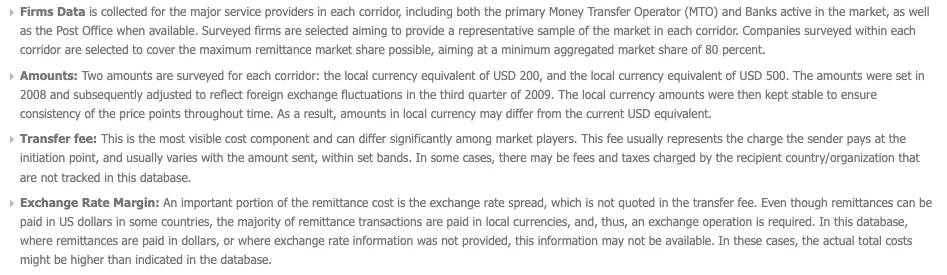
The World Bank's Remittance Prices Worldwide methodology breaks the price of a remittance into parts. The transfer fee is the most visible one. It usually represents the charge the sender pays at the point where the transfer starts, and it usually varies with the amount sent, within set bands. The second part stays out of sight: “An important portion of the remittance cost is the exchange rate spread, which is not quoted in the transfer fee.” This spread is the exchange rate margin.
The third place is the receiving end. The World Bank notes that in some cases there may be fees and taxes charged by the recipient country or organization that its database does not track. The US Consumer Financial Protection Bureau (CFPB) tells a sender whose recipient got less than was sent that a third-party company processing the transfer, or the recipient's bank, may have deducted fees or taxes.
| Where it goes | Who takes it | On a receipt issued in the United States | How to check it |
|---|---|---|---|
| Transfer fee, plus any tax the provider collects | The sender's provider, when the transfer is paid for | Shown as Transfer Fees and Transfer Taxes | Take the amount being transferred away from the total the sender paid |
| Exchange rate margin | Taken through the exchange rate used for the transfer | The rate is printed as Exchange Rate. The margin has no line of its own | Compare the printed rate with a reference rate for the same day |
| Fees and taxes on the way in | A third-party company that processes the transfer, or the recipient's bank | A third party's fees appear as Other Fees. For the recipient's own bank, a statement that fees may apply; the amount is optional | Compare Total to Recipient with what was credited, then ask the receiving bank or wallet what it deducted |
How do you work out the exchange rate margin from a receipt?
The margin is a number you work out yourself, with one subtraction and one division. You need two rates for the same day and the same pair of currencies: the rate printed on the receipt, and a reference rate. For the reference, use a market rate for that currency pair on the same day, and note where you took it from and at what time, because another source or another hour can give a different answer.
Write both rates as units of your currency for one unit of the sender's currency. Then:
margin % = (reference rate − rate on the receipt) ÷ reference rate × 100
Take a receipt for 200 dollars sent to a country whose currency stood at a reference rate of 100.00 to the dollar that day. The receipt shows a transfer amount of 200.00 dollars, a fee of 4.00 dollars, a total of 204.00 dollars, an exchange rate of 97.50 and 19,500.00 to the recipient. The margin is (100.00 − 97.50) ÷ 100.00 × 100 = 2.5%. In money, 200 dollars at the reference rate would have been 200 × 100.00 = 20,000.00, the receipt gives 200 × 97.50 = 19,500.00, and the missing 500.00 is worth 5.00 dollars at the reference rate. The fee is 4.00 dollars, which is 2% of the 200 being sent. Fee and margin together come to 9.00 dollars, or 4.5% of the 200.
If the account is then credited with 19,350.00, a further 150.00 has gone that the receipt does not account for, which points to the receiving side.
The reference has to be a rate between the two national currencies. A crypto price, such as the ones our crypto to local currency converter shows, follows a different market and is the wrong measure for a bank or money-transfer rate.
What a receipt has to show when money is sent from the United States
The United States sets this out in Regulation E. Its disclosure rules for remittance transfers say what a provider must give the sender before payment and again on the receipt. These are the lines that deal with the money, and a provider may use substantially similar wording for any of them:
- Transfer Amount: the amount that will be transferred to the recipient, in the currency the sender pays in.
- Transfer Fees and Transfer Taxes: fees imposed and taxes collected by the provider.
- Total: the transfer amount plus those fees and taxes.
- Exchange Rate: the rate the provider used, rounded to no fewer than two and no more than four decimal places.
- Other Fees: fees imposed by anyone other than the provider, in the currency the recipient will receive. What the recipient's own bank or other institution charges for receiving the money into an account is left out, unless that institution acts as the provider's agent.
- Total to Recipient: the amount the recipient will receive, in the receiving currency.
The last line is where a shortfall can hide. Total to Recipient is stated without taking off the receiving bank's own charges or taxes collected by someone other than the provider. Where those do or may apply, the receipt carries a statement that the recipient may get less than the amount shown. The provider may add the figure but is not required to.
The regulation's definitions describe the sender as “a consumer in a State”, sending primarily for personal, family or household purposes to a recipient at a location in a foreign country, and they exclude transfers of $15 or less. In other words, these rules cover money sent from the United States. This page sets out the US receipt rules only, not those for money sent from the Gulf, the United Kingdom or anywhere else. For those transfers, go by what the provider's own receipt shows and run the same comparison.
How the cost of your own transfer compares with the G20 target of 3% for sending $200
The G20 targets for cross-border payments, listed by the Financial Stability Board, include one on the cost of remittances: a global average cost of sending $200 of no more than 3% by 2030, with no corridor above 5%. A corridor is one sending country paired with one receiving country.
This is a goal for 2030, set for averages. It binds no provider and says nothing about what transfers cost today. It still gives your own transfer a yardstick: the receipt worked through earlier costs 4.5% on 200 dollars before any receiving-side deduction, above the 3% world average the G20 is aiming for.
The fee usually moves in bands with the amount sent, so a percentage worked out on 1,000 dollars does not line up neatly with a target written for 200. The World Bank's database surveys two sizes: the local-currency equivalent of USD 200 and of USD 500.
What you and the sender can do when the amount received is wrong
Wherever the money was sent from, two steps are open. The sender goes back to the provider that took the payment, with the receipt and the transaction number, and asks it to account for the difference. You ask your bank or wallet what it charged to receive the transfer and whether any tax was taken. Give the sender the facts to work with: the date of the credit, the amount, and a screenshot or statement line that shows them.
If the money was sent from the United States, the sender also has these rights, described on the CFPB's page on problems sending money to another country:
- Report the problem to the company. A sender can do this up to 180 days from the date the funds are available, going by the date shown on the receipt. The company has to look into it within 90 days of being notified and must report the results. In some cases the outcome is a refund, or the transfer sent again at no extra cost.
- Take it to the CFPB if the company has not resolved it. The CFPB forwards the complaint to the company and works to get a response, generally within 15 days.
Cancelling is useful only while the money has not been collected or deposited: generally a sender in the United States can cancel an international money transfer within 30 minutes after it is sent, at no fee. That window has no bearing on whether a local mobile money payment can be reversed once it sits in a wallet.
Dollar payouts and how long a remittance takes
Is there an exchange rate margin when a remittance is paid out in US dollars?
If the sender also paid in dollars, nothing is converted on the way, so there is no rate to compare at that stage. The World Bank's methodology says that where remittances are paid in dollars, exchange rate information may not be available in its database, and the actual total costs might be higher than it indicates. The rate question returns when you change the dollars into local currency, and the same comparison with a reference rate applies there.
How long should a remittance take to arrive?
It depends on the product. The World Bank's database records speed for each product in six bands, from less than one hour to six days or more. A receipt for money sent from the United States must show the date the funds will be available to the recipient, labelled Date Available or similar. The G20 has a target for the end of 2027: 75% of remittance payments in every corridor available to the recipient within one hour of being started, and the rest within one business day.